Regaining independence and mobility after illness or injury
Regaining independence after the onset or progression of a medical condition can feel overwhelming, particularly when it comes to driving.
For many people, driving is integral to daily life. It supports independence, social connection, employment and participation in valued roles within the community. Returning to driving, or continuing to drive with vehicle modifications, often represents an important milestone in recovery and adjustment.
This guide outlines the process of returning to driving with vehicle modifications and the role of occupational therapy in supporting this journey.
How do I know if I need vehicle modifications?
You may require vehicle modifications if a disability or medical condition affects your ability to:
access the vehicle independently
stow mobility aids without assistance
operate standard vehicle controls safely
Vehicle modifications are not suitable for everyone. It is important to consider other options first, such as driving rehabilitation, existing vehicle adjustments or low-tech solutions.
An Occupational Therapy Driving Assessment (OTDA) is essential to determine whether modifications are appropriate. This process includes working closely with a Vehicle Modifier to assess:
whether vehicle modifications are recommended
which modifications best suit your current and long-term function
compatibility with your vehicle
interaction with your environment, mobility devices and other Assistive Technology (AT)
Subtle differences in equipment can make a significant difference to adaptability and long-term use. Drive On Therapy supports you to identify the most appropriate solution.
Why is my licence medically suspended?
Following a significant medical event, such as a Spinal Cord Injury (SCI) or Acquired Brain Injury (ABI), hospital policy may recommend suspension of your driver’s licence. The Department of Transport and Major Infrastructure (DTMI) may act on this information and suspend your licence on medical grounds.
Your licence may also be medically suspended if you report a medical condition that requires further assessment to determine fitness to drive.
Mandatory reporting of medical conditions that could impact driving is a legal requirement in Western Australia. Further information is available via the Department of Transport website or in our blog on mandatory medical reporting.
If your licence is medically suspended, medical clearance from your treating doctor is required before returning to driving. This is often provided in the form of a referral for an Occupational Therapy Driving Assessment.
Once received, and provided there are no other restrictions on your licence, DTMI will issue Drive On Therapy with a permit to complete the OTDA.
What happens during an Occupational Therapy Driving Assessment for vehicle modifications?
The Occupational Therapy Driving Assessment is completed in two stages.
1. Off-road evaluation
The assessment begins with a comprehensive review of your medical and driving history, followed by functional assessment of skills required for driving. This includes:
- range of movement and strength
- vehicle access and transfers
- coordination and reaction time
- vision and cognitive skills
- ability to learn and adapt to vehicle modifications
- driving environments, mobility devices and assistive technology requirements
This stage helps determine which vehicle modifications may best support safe vehicle access and operation.
2. On-road vehicle trials
You will then trial a range of vehicle modifications in a dual-controlled vehicle. These may include:
- hand controls
- spinner knobs
- left-foot accelerators
- equipment for vehicle access and mobility device stowing
On-road trials are often completed over multiple sessions to allow sufficient time to trial different equipment and environments. This ensures:
- compatibility with your home or workplace (for example, garage access)
- safe vehicle access in community environments
- comprehensive assessment beyond vehicle operation alone
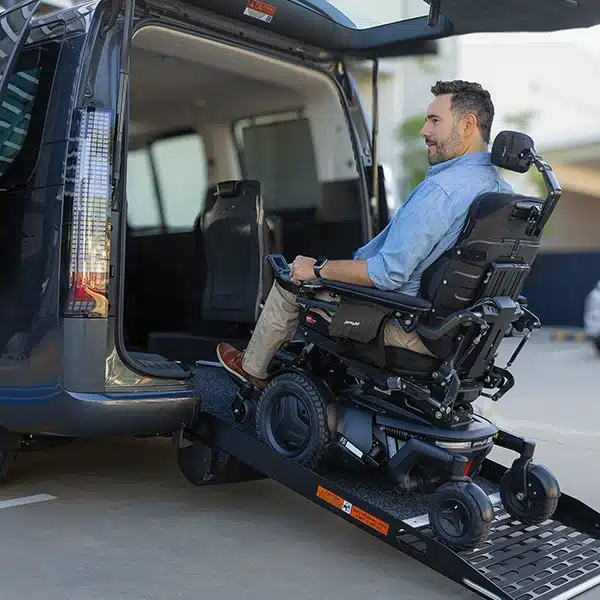
This is particularly important for Wheelchair Accessible Vehicles (WAVs), where multiple sessions are often required to assess access, wheelchair stowing, postural supports and driving aids.
I’ve completed the assessment – what happens next?
Once suitable vehicle modifications are identified, Drive On Therapy will prepare a detailed report for the DTMI and your medical team.
You may also be required to see your treating doctor to complete a Medical Assessment Certificate (M107A). Your occupational therapist will advise if this is necessary.
In most cases, a period of driver rehabilitation is required to build skills to a safe licensing standard using the prescribed driving aids. This may also include training to independently access the vehicle and manage mobility aids.
If your licence is medically suspended, DTMI will issue a permit allowing rehabilitation to occur under the supervision of a licensed Driving Instructor.
Driver rehabilitation: learning to drive with vehicle modifications
Drive On Therapy’s Driver Trained Occupational Therapists are also licensed Driving Instructors, allowing all rehabilitation and training to be provided in-house using dual-controlled vehicles.
This integrated therapy model includes:
- collaborative goal-setting aligned with best practice and realistic timeframes
- extended equipment trials to allow adjustment or customisation before vehicle fit-out
- building confidence and competence across varied road conditions
- ensuring safe access to common community destinations such as shopping centres, workplaces, medical appointments and family or friends’ homes
Every person’s journey is unique, and timelines will vary depending on the individual, vehicle, modifications and environment.
Final assessment and licensing
When ready, you will complete a Practical Driving Assessment (PDA) with your Occupational Therapist, in collaboration with a licensed Driving Instructor. This is referred to as an Occupational Therapy Fitness to Drive Assessment.
A report will be provided to DTMI with licensing recommendations. You will also be required to see your treating doctor to complete another M107A Medical Assessment Certificate.
The Department of Transport and Major Infrastructure makes the final licensing decision. In some cases, a further DoT Practical Driving Assessment may also be required.
Licensing conditions may include:
- use of specific driving aids
- restriction to automatic vehicles
- periodic medical review with your doctor, depending on the medical condition
Vehicle modifications and funding support
- National Disability Insurance Scheme (NDIS)
- Insurance Commission of WA (ICWA)
- Job Access Employee Assistance Fund (EAF)
- Workers Compensation Insurance
- Support at Home packages
Each funding program has specific eligibility criteria and processes. Vehicle modifications are generally required to meet long-term needs and demonstrate value for money. We recommend discussing options with your program representative.
Ready to begin your journey back to driving?
Returning to driving with vehicle modifications is possible. With the right assessment, training and support, you can work toward safe and independent driving again.