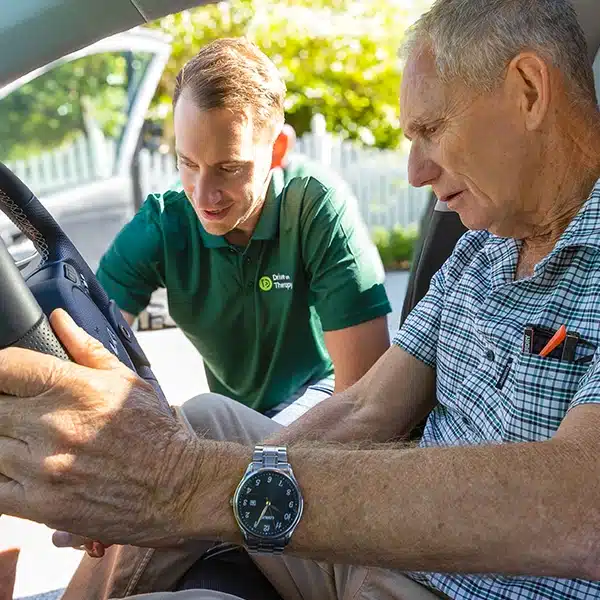

Understanding how NDIS-funded specialised driver training supports learning to drive
Learning to drive is a major milestone. For many people with a disability, the pathway to gaining a licence can look different and may require additional supports. Specialised driver training plays an important role in building the skills needed to drive safely, independently and with confidence.
At Drive On Therapy, we’re often asked how NDIS-funded specialised driver training works, who it’s for, and why an occupational therapy driving assessment is always the first step. This article breaks down what you need to know.
What is specialised driver training?
Specialised driver training is driving instruction delivered by a qualified driving instructor with additional training and experience supporting people with a disability. It may include:
- training in the safe use of vehicle modifications for people with a physical disability, such as learning to drive with hand controls following a spinal cord injury
- individualised teaching strategies for people who require additional support due to cognitive, sensory or neurodevelopmental differences
The NDIS considers Specialised Driver Training a disability-related support that helps participants build independence and access the community. It sits under Capacity Building – Improved Daily Living and is listed as support item 15_046_0129_1_3 in the NDIS Pricing Arrangements and Price Limits (PAPL).
This support item is subject to quotation and must be specifically stated in a participant’s NDIS plan. Even when included, a new quote is often required to access approved funding.
Can specialised driver training be funded by the NDIS?
This is one of the most common questions we receive, and the answer is straightforward:
An occupational therapy driving assessment must be completed first.
The assessment helps determine:
- whether driving is a safe and realistic goal
- what supports, including vehicle modifications or driving aids, may be required
- whether specialised driver training meets the NDIS criteria of being reasonable, necessary and value for money
The NDIS requires evidence before funding specialised driver training. An occupational therapy driving assessment provides this evidence by clearly linking the training to the participant’s disability, goals and likelihood of achieving a licensing outcome.
It’s also important to understand that pursuing driving may not always be recommended, or alternative strategies may be identified to build driving-related skills without specialised driver training.
Understanding changes to your NDIS plan
Adding specialised driver training to a NDIS plan may result in changes to the plan, such as a variation or reassessment. These processes can take time and may involve reviewing other funded supports.
Because plan changes can affect broader funding arrangements, we recommend discussing this with your Local Area Coordinator (LAC) or Support Coordinator before proceeding. Further guidance is available in the NDIS Operational Guidelines for Vehicle Modifications and Specialised Driver Training.
Value for money: what does the NDIS consider?
Value for money is a core principle of the NDIS. For specialised driver training to be funded, the NDIA must be satisfied that the support is likely to reduce long-term costs.
This may include considering whether gaining a driver’s licence will:
- reduce or eliminate the need for funded transport or support workers
- increase independence and reduce reliance on ongoing capacity building supports
- reduce the need for informal supports, such as family or friends assisting with transport
While these considerations can feel transactional, they are part of how insurance-based schemes allocate limited resources. If a support does not demonstrate value for money, it is unlikely to be funded.
An occupational therapy driving assessment evaluates value for money alongside other reasonable and necessary criteria. We provide clear and honest advice to help manage expectations.
How does “reasonable and necessary” apply?
Let’s consult the Oxford Dictionary for this one.
Reasonable (adjective)
Fair, sensible, and based on good judgement. Something is reasonable when it is appropriate for the situation and not excessive or extreme.
Necessary (adjective)
Required, essential, or needed for a particular purpose. Something is necessary when it must be done or provided in order to achieve an outcome.
Under the NDIS Act (2013), reasonable and necessary refers to rules whether a support can be funded. A NDIS support, such as Specialised Driver Training is considered reasonable and necessary when it:
Directly relates to the participants disability
The functional impact of the disability is established through an Occupational Therapy Driving Assessment to determine the need for Specialised Driver Training.
Helps pursue goals, build independence and participation in daily life
Gaining a drivers licence must clearly contribute to the achievement of goals stated in the NDIS plan, and assist with building engagement in the community with less assistance.
Is good value for money
Results in less costs to the NDIS long-term.
Is likely to be effective and beneficial
Engaging in Specialised Driver Training will result in achievement of gaining the drivers licence. It has been identified that the participant has a strong potential gain their licence through this particular support.
Doesn’t include everyday living costs
It must be established that Specialised Driver Training is necessary opposed to other mainstream supports that are incurred by people without a disability. This means not all driving lessons could be funded, because most learning drivers without a disability also access a driving instructor. It also means that Specialised Driver Training is not a substitute to supervised driving provided by informal supports such as family and friends.
Doesn’t duplicate supports form other systems
It must be identified that the NDIS is the most appropriate avenue for funding Specialised Driver Training. If the funding for Specialised Driver Training could come through another source, such as state-government initiatives or compensation schemes, this should be explored first.
How much does specialised driver training cost?
The NDIS pricing arrangements outline the cost structure for specialised driver training under support item 15_046_0129_1_3. There is no fixed national price limit, as the support is highly individual and may require additional time, equipment or travel.
Your Support Coordinator, Local Area Coordinator or Plan Manager can assist in understanding how this fits within your plan budget.
Why won’t the NDIS fund all driving lessons?
The NDIS does not consider Specialised Driver Training as a replacement for supervised driving with family, friends and other informal supports. There is always an expectation that immediate family, a relative or a suitable friend will assist with teaching to drive.
Exceptions may apply when a participant requires vehicle modifications or driving aids, and they do not have access to their own vehicle considered appropriate to modify. Learning to drive can be anxiety-provoking for parents, particularly when supporting their child with a disability. You may feel unsure where to start or how to structure your teaching.
Specialised Driver Training (and other supports, such working with a Driver Trained Occupational Therapist) may also be used to build the capacity of the family – to help them engage in their own lessons together.
Driving is a team effort, involving everyone – and with the right supports, you can play a pivotal role with confidence, and have a lot of fun along the way!
What next?
If you’re seeking specialised driver training – start with an occupational therapy driving assessment.
At Drive On Therapy, we’re proud to offer comprehensive assessments of the potential or fitness for an individual to drive, including the need for vehicle modifications.
We will provide you expert advice surrounding supports to gain a licence, such as specialised driver training among other recommendations.
Where recommended, we will gather all of the evidence to request for NDIS-funded specialised driver training.
Ready to explore your pathway to driving?
If you’re considering specialised driver training and want clear advice about your options, we’re here to support you.