How implementing the P-DRIVE has improved the quality, consistency and accuracy of our practice
One of the most significant developments in our service has been the implementation of the Performance Analysis of Driving Ability (P-DRIVE) — a structured assessment tool that strengthens the way we observe, interpret and report on driving performance.
What is P-DRIVE?
P-DRIVE is a standardised observational assessment tool used by Occupational Therapists to evaluate a person’s ability to drive safely and competently in real traffic conditions.
Rather than focusing only on isolated impairments or underlying skills, P-DRIVE takes a top-down approach. It looks at driving as a complete task — observing how someone performs behind the wheel and responds to real-world driving situations.
The assessment includes 25 driving actions grouped across key areas such as:
- Vehicle handling and manoeuvres
- Orientation and planning
- Following road rules
- Attending and responding to the environment
Each area is scored using a structured scale, helping provide a clear picture of how safely and effectively someone is driving.
How is P-DRIVE used in practice?
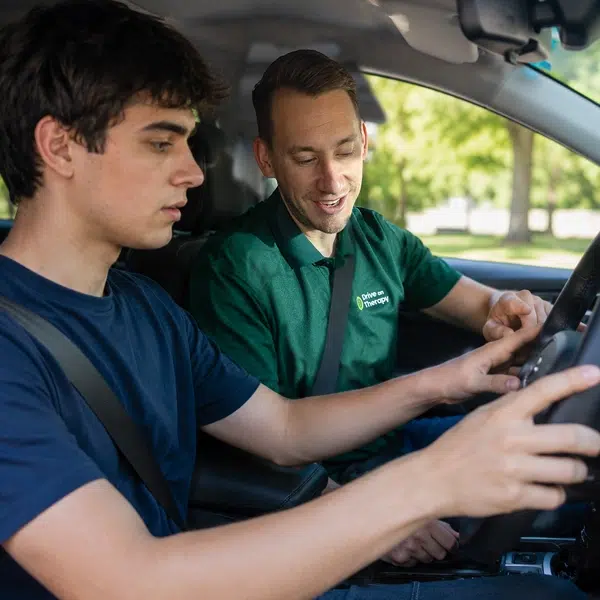
Within our Occupational Therapy Driving Assessments, P-DRIVE provides a structured framework to observe and evaluate on-road driving performance.
During the assessment:
- your Occupational Therapist observes your driving performance during the on-road component
- specific behaviours, decisions and responses are documented
- performance is scored based on direct observation rather than assumptions
This approach moves beyond general impressions and helps ensure assessments are structured, measurable and consistent.
Why we implemented P-DRIVE
Historically, on-road driving assessments have relied heavily on clinical judgement, which can naturally vary between clinicians and services.
We implemented P-DRIVE to introduce greater consistency, structure and objectivity into our practice. It provides a shared framework that supports all therapists to assess driving in a more standardised and transparent way.
Importantly, P-DRIVE does not replace clinical reasoning — it strengthens it by providing a clearer foundation for decision-making.
How P-DRIVE strengthens our service
Since implementing P-DRIVE, we’ve seen clear benefits across our service.
Using a shared assessment framework improves consistency in how assessments are completed and how recommendations are made.
By focusing on observable behaviours and structured scoring, we reduce reliance on subjective impressions alone. This supports more accurate and transparent outcomes.
P-DRIVE is also backed by strong research, providing confidence in its ability to support clinical decision-making and identify driving risk appropriately.
Importantly, P-DRIVE includes scoring ranges that help guide recommendations regarding whether someone is:
- likely safe to continue driving
- likely to benefit from driver rehabilitation to build or regain skills demonstrating
- performance concerns that may indicate driving is no longer safe
Research also shows that when different therapists use P-DRIVE, they are likely to reach similar conclusions. This level of agreement is a strong indicator of assessment quality and reliability.
How this improves client outcomes
Ultimately, the biggest impact of P-DRIVE is on the people we support.
Driving is closely linked to independence, identity and participation in everyday life. Because of this, decisions about driving must be made carefully, fairly and accurately.
Using P-DRIVE allows us to:
- identify unsafe driving behaviours that may place someone at risk
- distinguish between minor difficulties and more significant concerns
- support safe drivers to continue driving where appropriate
- provide clearer and better-supported recommendations when driving cessation is necessary
This contributes to safer outcomes, clearer communication and greater confidence for clients, families and referrers.
Looking ahead
The implementation of P-DRIVE reflects our ongoing commitment to clinical excellence and continuous improvement.
As we continue refining our practice, tools like P-DRIVE help ensure we are:
- delivering high-quality Occupational Therapy Driving Assessments
- aligning with current best practice
- supporting clients with clear and evidence-based recommendations
At Drive On Therapy, this commitment underpins every assessment and every recommendation we make.
Looking for an evidence-based driving assessment?
Our Occupational Therapy Driving Assessments combine clinical expertise with structured, evidence-based tools such as P-DRIVE to support safe and informed driving decisions.