Whether you’re recovering from a recent injury or have been living with an SCI for some time, the questions below cover what we’re most often asked about returning to driving, from reporting requirements and vehicle modifications to rehabilitation and funding in WA. Please note, this blog should be viewed as a discussion point only. It is not intended to replace individualised advice from a medical practitioner or an Occupational Therapy Driving Assessment.
Will a spinal cord injury impact my driving?
An SCI may impact motor (movement) and sensory (feeling) function from the point of injury and below. How it impacts your function depends on which spinal segment is injured and the severity of the injury.
SCIs are normally classified using the International Standards for Neurological Classification of Spinal Cord Injury (ISNCSCI). These standards include the ASIA Impairment Scale, which is why they are more commonly referred to as the ASIA scale. Speak to your medical team to learn more about your level of SCI and what function is likely to be impacted. More information on the ISNCSCI can be found here: ISNCSCI resources | American Spinal Injury Association
An SCI may impact your ability to feel or locate the brake and accelerator pedals, your ability to push the pedals and brake in time, or your steering, indicating and ability to observe the driving environment.
Everyone is different, and the impact on driving is best determined by completing an Occupational Therapy Driving Assessment with a Driver Trained Occupational Therapist who is familiar with assessing fitness to drive and vehicle modifications.
Is a spinal cord injury reportable to the Department of Transport and Major Infrastructure (DTMI)?
Yes, an SCI is a reportable condition. If you haven’t already, please disclose the injury to the DTMI through this link: Report a medical condition | Transport WA
It is mandatory for a licence holder to report to the DTMI any medical condition that may impair their capacity to operate a motor vehicle. More information on mandatory reporting can be found here: Mandatory medical reporting and driving in WA: what you need to know
I have a lumbar SCI and can still walk short distances without mobility aids. Will I be okay to drive an unmodified vehicle?
It will depend on where in the lumbar spine the SCI occurred, and whether the injury is complete or incomplete and impacts one or both sides of the body.
For example, if the injury is higher in the lumbar spine (L2/3), there is a greater likelihood that you will have difficulty operating the accelerator and brake pedals due to notable impairment in hip, knee and ankle mobility. If your SCI is lower in the lumbar spine, there is a greater likelihood that you can drive an unmodified vehicle.
For example, you may have an L4/5 SCI and use an ankle-foot orthosis (AFO) to stabilise your ankle. While your ability to move the ankle is limited, you may have adequate movement in your hip and knee to compensate for the loss of ankle movement and use the pedals safely.
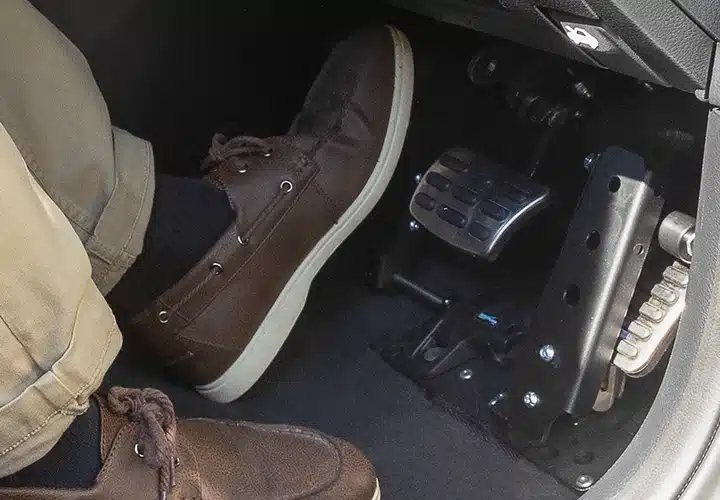
The impact on sensation, coordination, fatigue and brake reaction times must also be considered when evaluating a return to driving an unmodified vehicle. Sometimes, a simple solution can be found if the SCI mostly impacts one side of the body, such as a left foot accelerator that swaps pedal control from the right leg to the left leg.
I have a thoracic SCI and use a manual wheelchair for all mobility. What can I expect when driving?
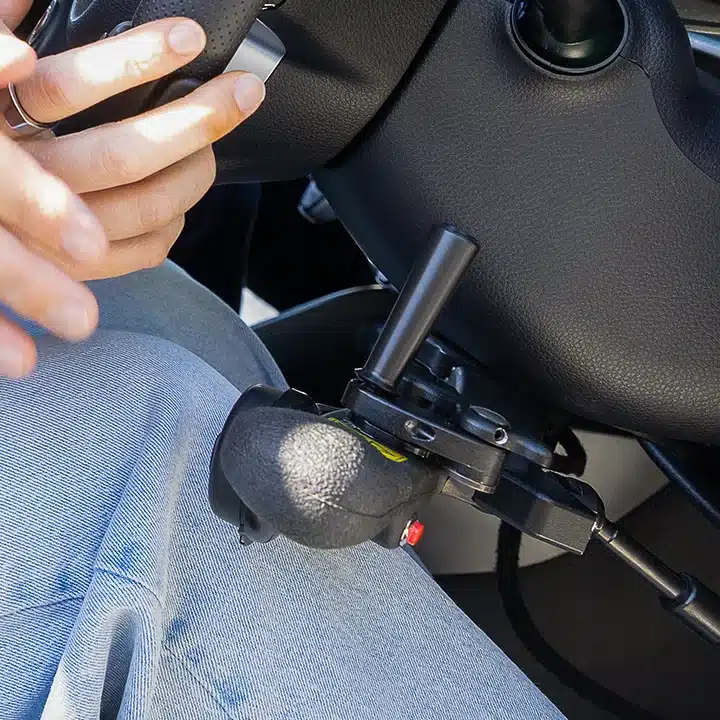
If the SCI is complete, this will mean you require modifications such as hand controls to safely return to driving. Hand controls adapt the vehicle so you can brake, accelerate and steer using your upper limbs. Postural supports may also be required to assist with balance when turning corners. There are many solutions readily available.
For more information on hand controls, follow this link: Hand controls for driving in WA.
Transferring into the vehicle
Often, the main challenge with a return to driving is not the driving itself, but transferring into the vehicle and loading and stowing your wheelchair.
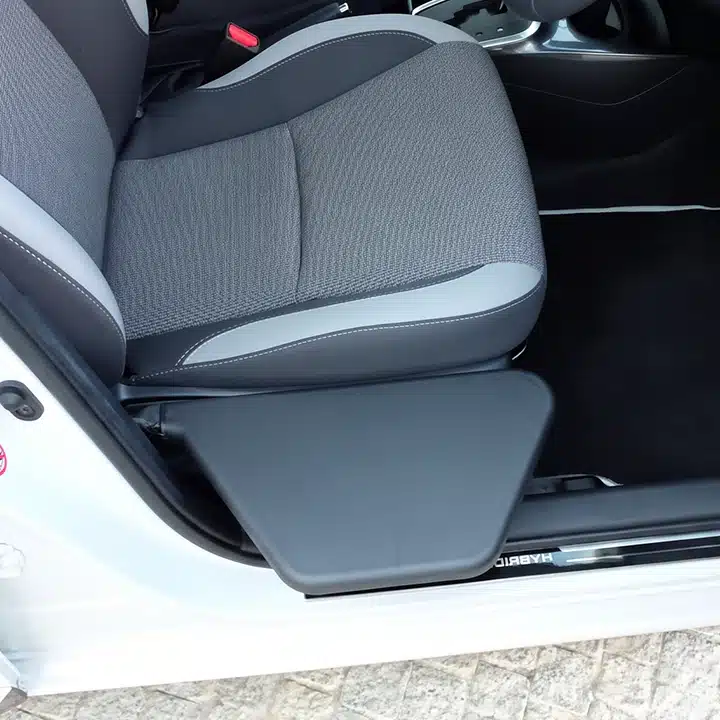
You may be able to simply slide across using a slide board or lift yourself across from the wheelchair to the driver’s seat. You may then be able to dismantle the wheelchair and lift it across your body to safely stow it on the passenger seat.
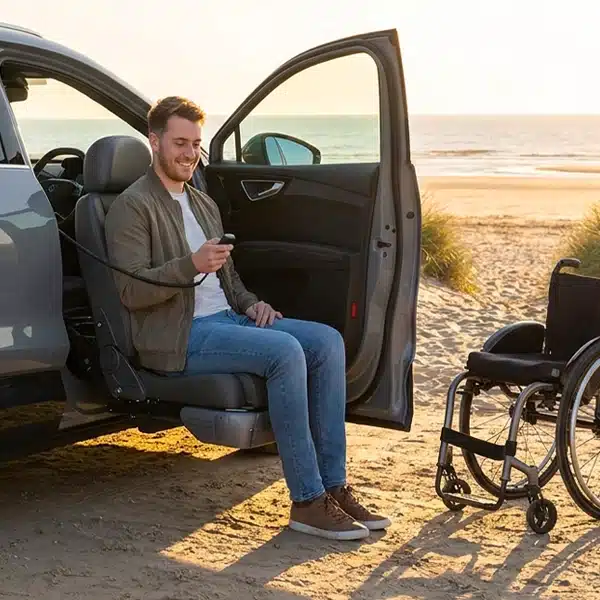
Several devices other than a slide board are available to assist with transfers, including tip-up plates, hoists and seats that rotate out of the vehicle.
Stowing your wheelchair

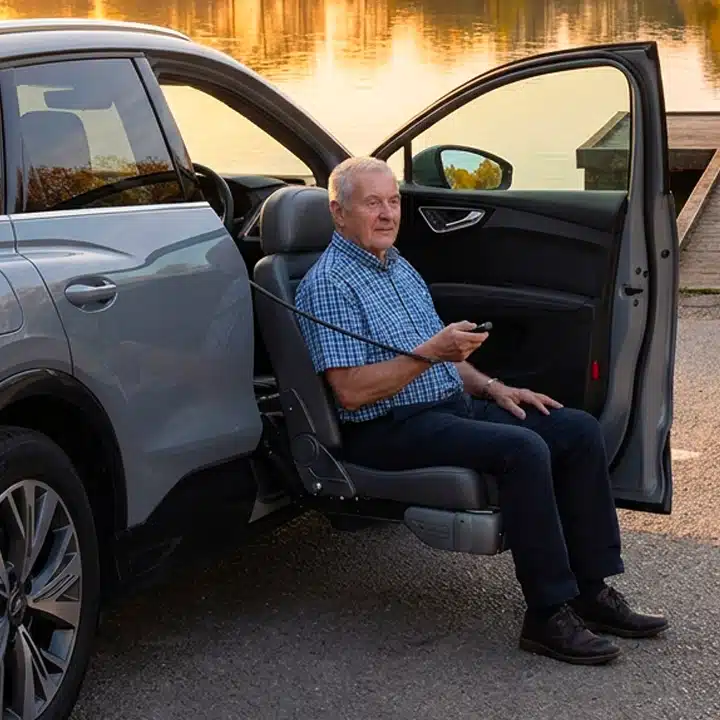
Stowing the wheelchair can also be achieved using Assistive Technology (AT), ranging from rooftop wheelchair carriers through to robotic arms or platform lifts mounted behind the driver’s seat or in the boot of the vehicle.
Wheelchair Accessible Vehicles (WAVs)

Sometimes the best option is to move to a Wheelchair Accessible Vehicle (WAV) that you can enter while still seated in your wheelchair. You may then transfer to the driver’s seat inside the vehicle or drive from your wheelchair, depending on your function. A WAV and other advanced vehicle access and wheelchair stowing devices require thorough assessment with your Occupational Therapy Driver Assessor and vehicle modifier to determine an appropriate solution, including vehicle compatibility.
I have incomplete quadriplegia from a cervical SCI and use a power wheelchair for all mobility. What could driving look like for me?
In most cases, this will mean driving the vehicle from your power wheelchair. This requires a very comprehensive process of assessment and rehabilitation, alongside a vehicle modifier, to design an appropriate WAV.

A return to driving is not always possible in this situation. However, there are now several advanced (often referred to as high-level) driving aids available for drivers with advanced needs.
Please follow this link for more information: Joysteer 3.0 Driving Controls.
I’ve completed an Occupational Therapy Driving Assessment and know the equipment I need to get back to driving. What happens next?
A period of driving rehabilitation will then follow. We’re often asked, “How many sessions will I need?” As much as we’d like to give a defined number, this is individualised and something we can’t predict until we complete the Occupational Therapy Driving Assessment.
Some people won’t require any equipment and simply need time behind the wheel to regain their confidence or adapt to less significant changes in function. Other people adapting to standard hand controls may similarly need only a short period of rehabilitation because of prior experience riding motorcycles or operating hand-operated machinery. For others, there may be several reasons why the rehabilitation journey takes longer, such as complex motor and sensory needs, or psychosocial factors including anxiety about returning to driving, depending on how the SCI occurred.
At Drive On Therapy, you will normally complete your rehabilitation with an Occupational Therapy Driver Assessor and Driving Instructor (OTDA-DI). An OTDA-DI is an advanced Occupational Therapy practitioner qualified in driving instruction, with a thorough understanding of rehabilitation and disability, to meet the needs of people with a medical condition seeking to return to driving.
More information is available here: Returning to driving with vehicle modifications.
I’m learning to drive for the first time. Does this change anything for me?
Gaining your licence may look different to your friends’ experience, due to the use of equipment and completing most, if not all, of your lessons with an OTDA-DI or Specialised Driving Instructor.
After passing your DTMI Learner’s Theory Test and disclosing your SCI to the DTMI, you will be asked to complete a Medical Assessment Certificate (M107A) with your General Practitioner (GP). If not done already, this may trigger a referral to Drive On Therapy (or another Occupational Therapy Driving Assessment provider) to evaluate your needs. Once this medical process has been completed and you are considered a suitable candidate to gain a driver’s licence, your learner’s permit will be issued. From that point on, the process is the same as for any other learner driver.
More information on getting a licence can be found here: Get a licence.
Is there funding available to install vehicle modifications in my own vehicle?
Yes, funding is available through various funding bodies, including the National Disability Insurance Scheme (NDIS), Insurance Commission of Western Australia (ICWA), Department of Veterans’ Affairs (DVA), the My Aged Care Support at Home program, Workers’ Compensation and other insurance schemes. There are often conditions or limitations to funding. Please contact us or speak with your funding body for more information.
The NDIS provides detailed information on what the scheme can fund in its operational guideline: Vehicle modifications and driving supports.
Ready to get driving?
Get in touch. Referrals can be made here: Driving occupational therapy referral form If you have any further questions, please contact us through our online enquiry form, phone (08) 6287 9115 or email hello@driveontherapy.com.au.